
What the Data Is Telling Us
Last Updated: July 2026
Resilience has become one of the most critical leadership capabilities in today’s rapidly changing business environment.
Yet despite nearly universal agreement on its importance, a growing body of data shows a substantial gap between the perceived importance of resilience and its actual development among leaders and employees.
This article synthesizes the latest research on resilience in leadership and the workplace, highlighting where organizations are strong, where they are falling short, and why this matters.
All data reflects the most recent available research as of mid-2026.
The Leadership Resilience Gap
Nearly all leaders recognize the importance of resilience, but far fewer are confident in their own resilience skills or their organization’s readiness.
According to a Forbes analysis, 46% of leaders report they lack sufficient resilience skills to address core business challenges, and only 25% of leaders globally are seen as leading highly resilient organizations — even though 97% recognize resilience as necessary.
Only 31% of leaders feel ready to meet future challenges and uncertainty, according to a McKinsey Global Resilience survey of more than 300 leaders.
In the same context, 61% of business leaders say resilience is the most essential quality for future business success.
Despite this recognition, many managers still feel underprepared. One leadership resilience study cited that 72% of managers report feeling overwhelmed by constant change and uncertainty.
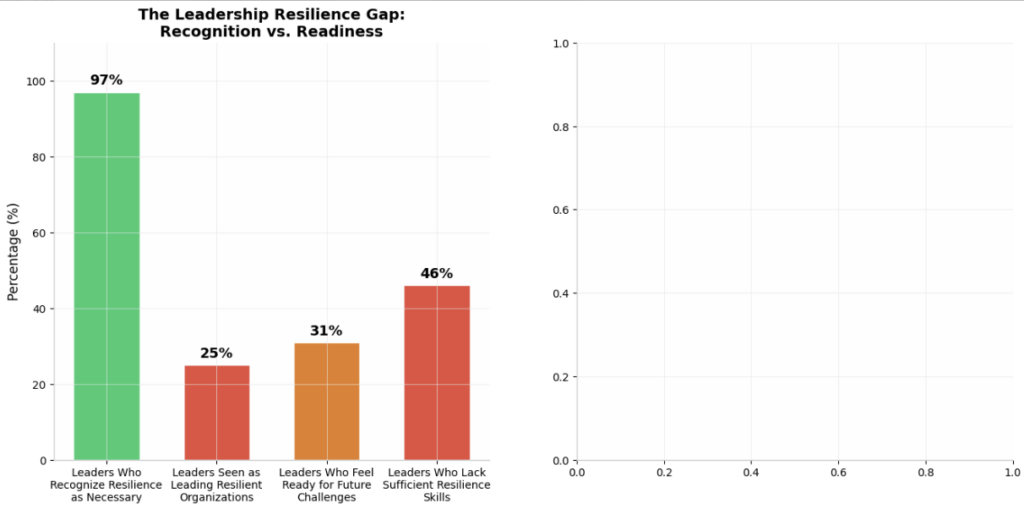
Figure 1: Data compiled from McKinsey Global Resilience Survey and Forbes leadership analysis, 2024-2025.
Expert Interpretation
“The more leaders acknowledge resilience as essential, the more they admit they don’t have it. The gap isn’t ignorance — it’s implementation. Organizations are investing in resilience as a concept but failing to build it as a practiced capability.”— Dr. Taryn Marie Stejskal, founder of the Resilience Leadership Institute
The 72-percentage-point gap between recognition (97%) and organizational demonstration (25%) represents what researchers at the University of Pennsylvania’s Positive Psychology Center call “aspirational blindness” — the tendency to overvalue outcomes we haven’t yet achieved.
This distortion makes the gap harder to close because leaders may believe they are further along than objective measures indicate.
Employee and Organizational Resilience Levels
The resilience gap is not confined to leaders; it extends to employees throughout organizations.
- Only about 30% of employees are considered resilient, according to workforce surveys reviewed by Aon.
- Resilience strongly impacts motivation: 86% of resilient employees report high motivation compared with 44% of non-resilient employees.
- Research reported by PR in HR shows that resilient employees have 55% higher engagement and are 42% more likely to stay with employers than less resilient employees.
- Studies indexed in PubMed show that resilience correlates with higher job satisfaction and stronger work engagement.
These findings demonstrate that resilience is not just a personal attribute but a predictor of key organizational outcomes.
The Burnout Epidemic: 2026 Context
To understand the resilience gap fully, it must be viewed against the backdrop of record-level burnout. As of 2025-2026, 55% of U.S. workers are currently experiencing burnout — a six-year high. Globally, 67% of workers report burnout symptoms at their current job, up from 52% in 2021.
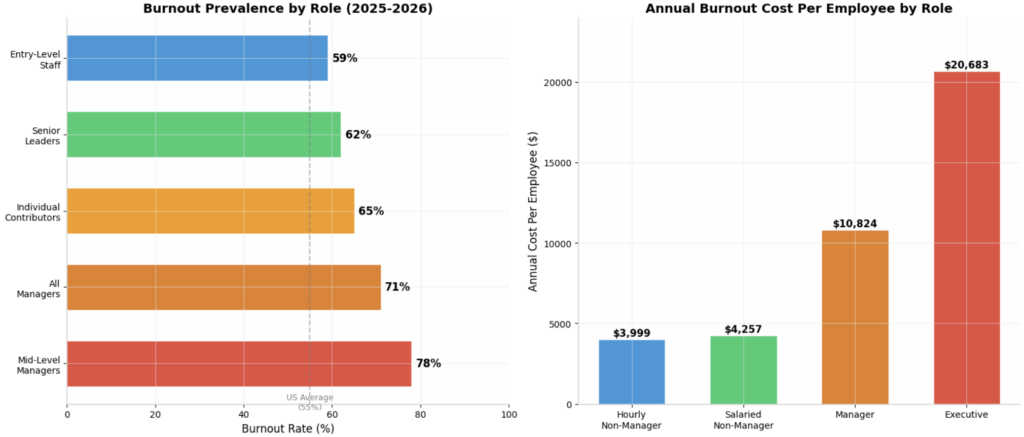
Figure 2: Left: Burnout rates by organizational role. Right: Annual per-employee cost of burnout by role. Data sources: Eagle Hill Consulting (2025), American Journal of Preventive Medicine (2025), Gallup (2025).
The cost is staggering. Burnout costs employers between $3,999 and $20,683 per employee per year, scaling with role. Critically, 89% of burnout’s cost comes from presenteeism — employees who are physically present but mentally depleted — not from absences. Most organizations track sick days, which captures only 11% of the problem.
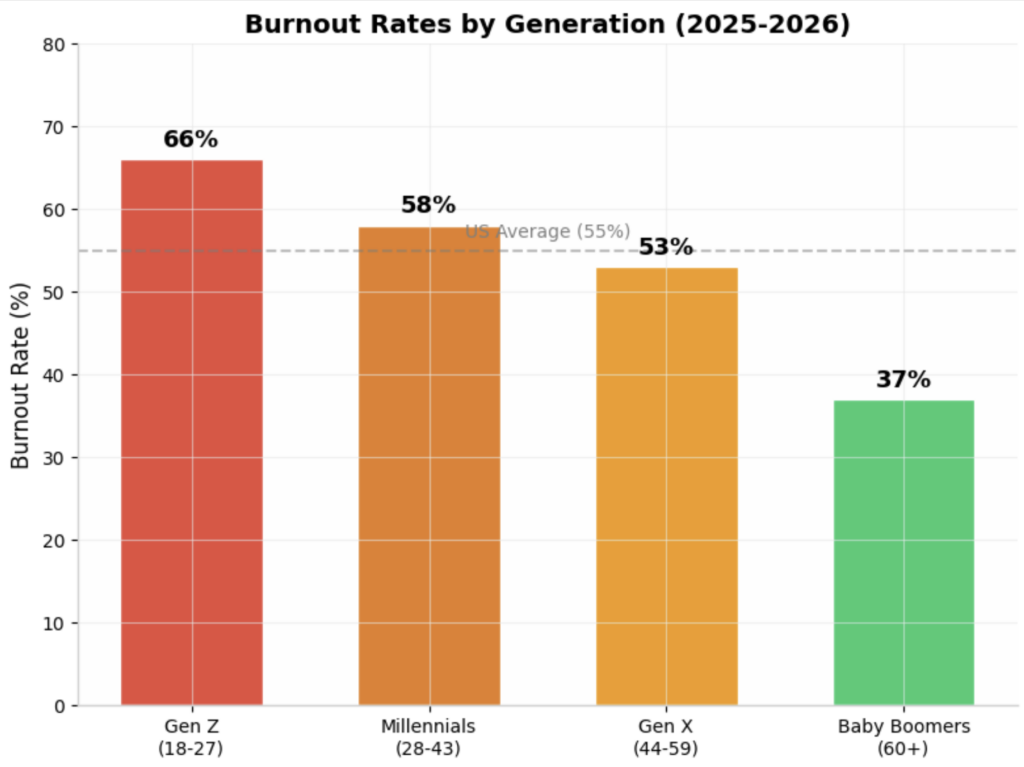
Figure 3: Burnout rates by generation, 2025-2026. Gen Z hits peak burnout at age 25 — approximately 17 years earlier than the average American worker. Data: Eagle Hill Consulting (2025), NAMI (2025).
The Impact of Manager and Leader Resilience
Managers play a critical role in shaping workplace resilience, yet many still need greater development in this area.
In one study of nurse managers, fewer than 15% had high resilience, with most falling into moderate or low categories; higher resilience was associated with more empowering leadership behavior. See PMC6111486.
Resilient leaders also positively influence employee growth and career optimism, supporting overall team resilience, according to research published on ScienceDirect.
Across broader populations:
- Line managers are found to influence about 14% of employee wellbeing — a significant proportion of overall wellbeing outcomes.
- Line managers report feeling 5% less resilient than senior managers and nearly 10% less resilient than directors and executives.
This shows that the leaders closest to day-to-day employee experience often have the least resilience support.
The Manager Burnout Crisis
The data on manager-specific burnout is particularly alarming. Mid-level managers post the highest burnout rate of any role group at 78%, above individual contributors at 65%. Manager engagement dropped to 27% globally in 2024.
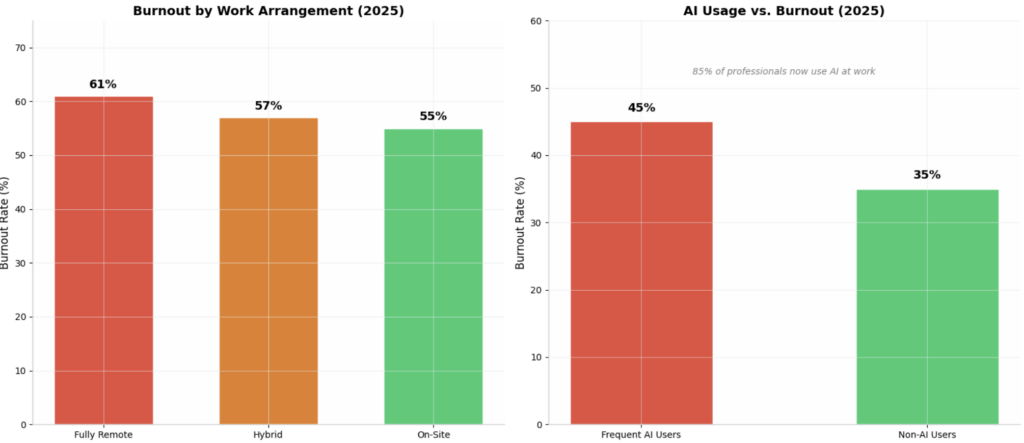
Figure 4: Left: Burnout by work arrangement. Right: AI usage correlates with higher burnout, contrary to expectations of efficiency gains. Data: Eagle Hill Consulting (2025), Moodle (2025).
A critical finding from 2025: frequent AI users report 45% burnout, against 35% of non-users. A UC Berkeley study found that AI at work adds responsibilities and hours rather than freeing time, as freed capacity gets filled with expanded scope. With 85% of professionals now using AI at work, this variable applies broadly.
Organizational Perspectives on Resilience
Organizations vary in their confidence and capabilities regarding resilience as a strategic capability.
- A global PwC resilience survey found that 70% of organizations feel confident in their ability to respond to disruptions — even though many still lack fully integrated resilience strategies.
- Only 16% of global employers invest in adaptability and continuous-learning programs — critical foundations for building resilience capacity.
- Resilience-related factors, including managerial resilience, explained 55.8% of the variance in organizational performance in a quantitative research model, demonstrating the strategic significance of resilience at work.
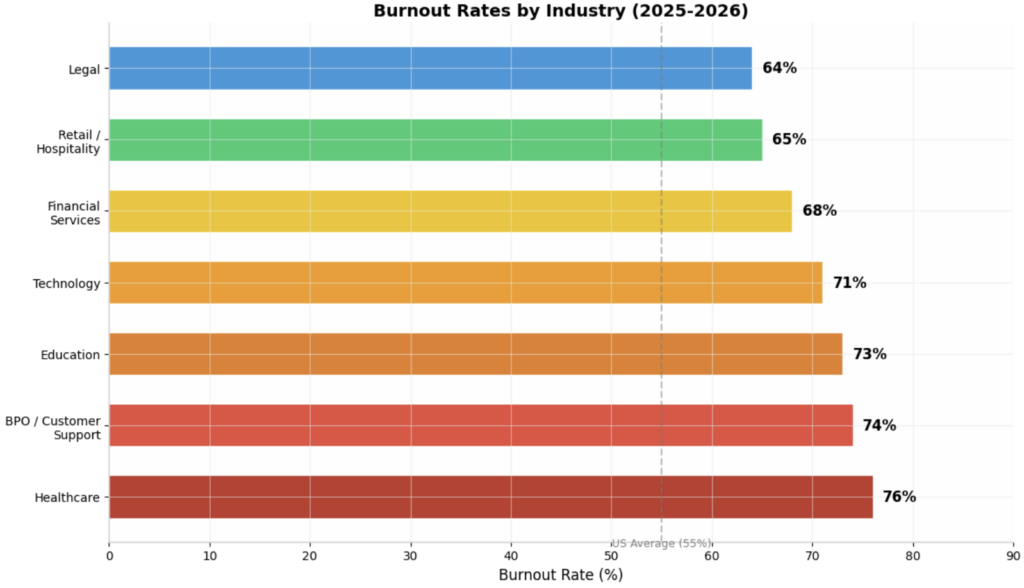
Figure 5: Burnout rates vary significantly by industry. Healthcare leads at 76%, driven by staffing shortages and emotional labor. Data: National Academy of Medicine, Haystack Analytics, ABA (2025).
The Global Engagement Decline
Resilience cannot be separated from the broader engagement crisis. Global employee engagement fell to 21% in 2024, with the cost of lost productivity reaching $438 billion.
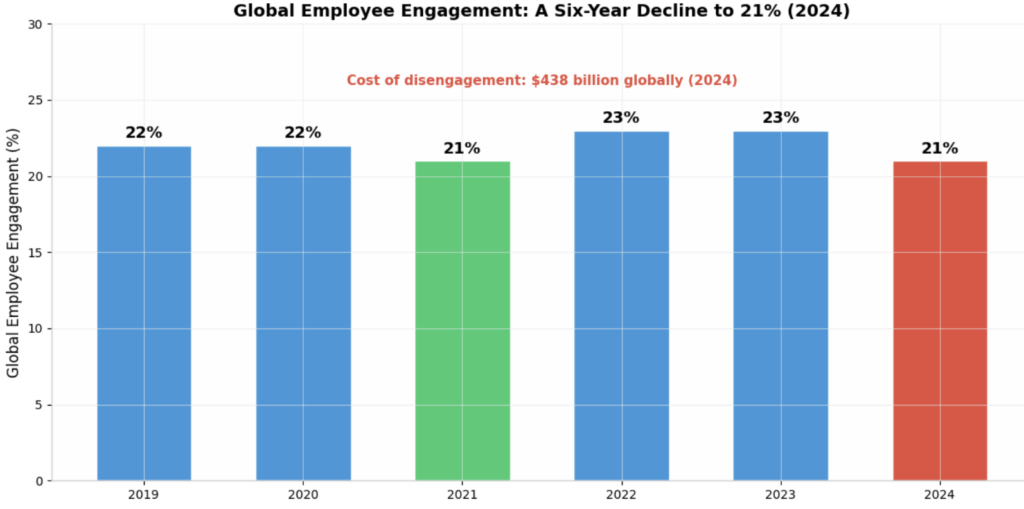
Figure 6: Global employee engagement has declined to 21% in 2024, with disengagement costing the global economy $438 billion annually. Data: Gallup State of the Global Workplace (2025).
Why This Matters: Implications for Managers
The research points to five critical implications for anyone in a management role:
1. The “Sandwich Layer” Is Collapsing
Mid-level managers — the organizational layer between strategy and execution — are burning out at the highest rate (78%) while receiving the least support. They are simultaneously asked to implement executive directives, absorb team distress, and maintain their own performance.
This structural pressure means individual resilience training, while valuable, is insufficient without organizational boundary-setting.
Practical recommendation: Organizations should audit manager workload distribution quarterly. Managers should be explicitly empowered to push back on scope expansion and provided with escalation pathways when demands exceed capacity.
2. AI Is Not Reducing Managerial Load
Contrary to productivity promises, AI adoption correlates with higher burnout. The mechanism is “capacity capture” — when tools create efficiency, organizations often expand expectations rather than reducing hours.
Practical recommendation: Managers should negotiate explicit agreements about how AI-generated time savings are allocated. Without intentional boundaries, efficiency gains convert to additional assignments.
3. Presenteeism Is the Hidden Cost
With 89% of burnout costs coming from presenteeism, managers cannot rely on attendance metrics. A team that shows up but operates at reduced cognitive capacity costs more than one with higher absenteeism but genuine recovery.
Practical recommendation: Shift performance metrics from presence to output quality. Implement “recovery rituals” — structured breaks, meeting-free blocks, and explicit off-hours boundaries — and model them personally.
4. Remote Work Requires Active Boundary Management
Fully remote workers report 61% burnout versus 55% for on-site workers. The cause is not location but boundary erosion: remote employees work an average of 2.5 additional hours per day.
Practical recommendation: Managers of remote teams should establish “core hours” with explicit start and end times. Calendar visibility should include blocked personal time, and after-hours communication should be delayed rather than sent immediately.
5. Resilience Is Contagious — In Both Directions
Managers account for 70% of the variance in team engagement, yet only 44% have received any formal management training. A burned-out manager creates a burned-out team; a resilient manager buffers team stress.
Practical recommendation: Organizations should prioritize resilience training for managers before rolling out workforce-wide programs. The return on investment is higher because of managerial multiplier effects.
Practical Recommendations for Closing the Gap
Based on the 2025-2026 data, organizations should prioritize the following evidence-based interventions:
| Intervention | Evidence Base | Expected Impact |
|---|---|---|
| Manager resilience training | Gallup: 70% of engagement variance driven by managers | 20-28% improvement in team performance |
| Structured flexibility (not unlimited) | Hybrid employees with team-set schedules report higher well-being than those with self-set schedules | Reduced burnout risk |
| Belonging-focused culture | Employees who feel they belong: 30% stress vs. 56% without belonging | 23-percentage-point burnout reduction |
| Early burnout detection (behavioral analytics) | Patterns appear 4-6 weeks before survey detection | 47% earlier intervention |
| Mental health benefit access + training | Only 53% of employees know how to access employer-provided mental health care | 2x likelihood of feeling no burnout |
Conclusion
Resilience is not just about weathering storms; it is about thriving through them. The research shows that:
- Resilience boosts engagement, motivation, job satisfaction, and retention.
- Managers directly influence employee well-being and team performance.
- Organizational confidence in resilience is often higher than actual capacity.
- Most resilience development gaps appear at the managerial and workforce levels.
- New variables — AI adoption, remote work arrangements, and generational shifts — are reshaping the resilience landscape in unexpected ways.
Resilient managers — those who can adapt, lead consistently under pressure, and support their teams through disruption — are increasingly strategic assets.
Conversely, resilience gaps signal significant risk not just to leaders, but to the people they lead and the organizations they steward.
Closing the resilience gap requires intentional investment in leadership development, wellbeing support systems, and cultures that encourage psychological safety, adaptability, and continuous learning.
The next decade of organizational performance will be shaped by those who can cultivate resilience not as an abstract ideal, but as a measurable capability embedded in everyday leadership practice.
Sources and Further Reading
- Gallup State of the Global Workplace 2025
- Eagle Hill Consulting Workforce Burnout Survey, November 2025
- American Journal of Preventive Medicine, Burnout Cost Analysis (2025)
- McKinsey Global Resilience Survey
- Aflac WorkForces Report 2025
- Mind Share Partners 2025 Mental Health at Work Report
- National Academy of Medicine: Clinician Burnout Research
- PMC6111486: Nurse Manager Resilience Study
- APA Work in America Survey 2025
- Mercer Global Talent Trends 2024
Note: This analysis was compiled in July 2026 from peer-reviewed research, large-scale employer surveys, and governmental occupational health reports. Where exact 2026 figures were not yet available, projections were made from the most recent data using published trend rates.